Resurgence of Faith In America & The Untold Story Why This Matters!
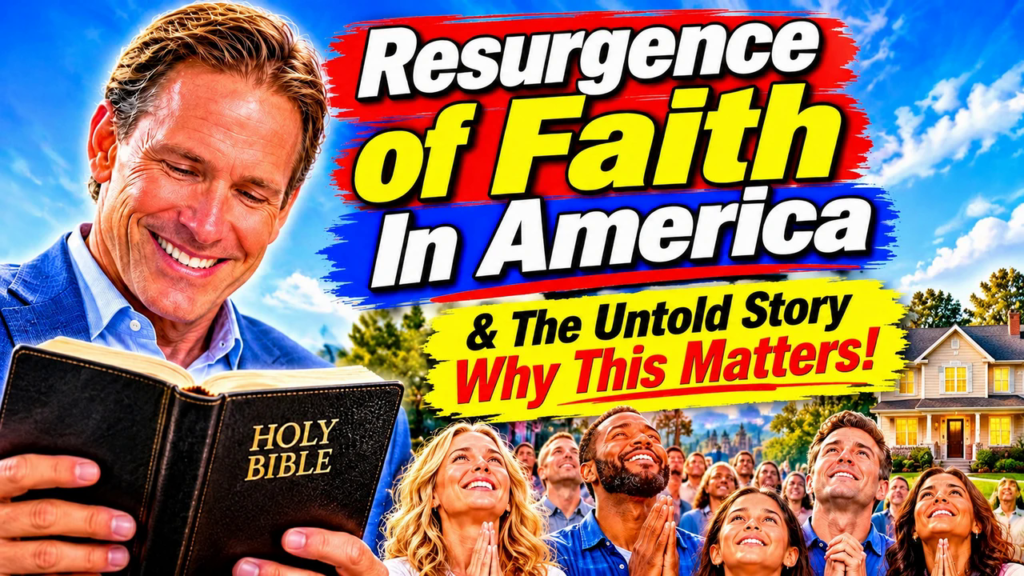
Resurgence of Faith in America: Is Faith Making a Comeback?
America was founded on moral values rooted in faith. However, over the last several decades, faith has held a less important place in people’s lives, and we have gradually drifted away from the values we once held so dear.
Researchers warn that this shift has real costs.
In recent decades, we’ve seen dramatic social changes: the breakdown of the family, the sexual revolution, abortion, drugs, alcohol, and increasing political and economic turmoil.
We see the effects all around us — rising loneliness, family breakdown, mental health struggles, and a growing sense of aimlessness.
Do Not Overestimate Your Opinion:
There is an ancient proverb that warns us about becoming wise in our own eyes.
Dr. Brian Clement of the Hippocrates Institute has said that when society began to think it could do better than living the way God — or, for the non-religious, the way Mother Nature intended us to live — things started to go bad for us.
Certain people in society began forcing their ideas on everyone else, and now, 60 years later, you can be a man in the morning, a woman in the evening, and back to a man again the next morning. Women are fighting for the right to kill their unborn children, and society is pushing the idea that men and women are the same.
Erica Komisar has said that we are deconstructing society by destroying the ideas of gender, ethnicity, and faith.
They are trying to make everyone the same.
She goes on to explain that structure makes people feel safe.
Not everything these institutions do is correct. However, they are consistent and provide something people can rely on. In modern life, the media and governmental influences are trying to eliminate much of our identity and traditional structure.
When ever society goes too far in one direction, it eventually tries to correct itself by moving in the opposite direction. Because of this, many people are returning to old traditional values.
In fact, many are returning to faith.
Over the last several decades, faith has become less important in many people’s lives, starting with the Baby Boomers.
Many of these people may still believe in God, but God often comes behind family, career, entertainment, and paying the bills.
But not for everyone.
Generation Z Does Not Want To Live Like Their Parents:
There is a growing segment of the population zealously returning to faith.
Especially Generation Z — particularly young men — because of the heartbreak they saw their parents go through with broken families, constant arguments, multiple partners, and unstable homes. Many young people now desire a stable family life and stronger moral direction.
The Times UK Report recently reported that Gen Z is much less likely to identify as atheist than their parents’ generation. This surprised many researchers because earlier surveys from the 2000s and 2010s predicted a steady rise in atheism.
Gen Z’s Return to Faith & Bible Engagement.
1. Growing Church Attendance (2025 Study)
In the UK, Gen Z church attendance reportedly increased from 4% in 2018 to 16% in 2023, with young men reaching 21% — what some are calling a “quiet revival.”
The United States is showing similar patterns, with Gen Z faith levels stabilizing and young men beginning to close the historical gender gap in religiosity.
2. Bible Use Is on the Rise.
In the United States, Gen Z scripture engagement reportedly rose from 11% to 15% between 2024 and 2025.
In the UK, Bible sales surged by 87% from 2019 to 2024, driven in large part by Gen Z interest.
3. Curiosity About Faith
A 2023 survey by the American Bible Society found that 44% of Gen Z adults reported being very or extremely curious about the Bible or Jesus, with even higher curiosity among younger Gen Z adults.
In 2025, more than 20% of Gen Z adults said they had increased their Bible use that year, while 54% reported that the Bible had changed their life.
Many non-practicing or non-Christian Gen Z individuals are also becoming more open to Scripture-based experiences, such as attending church services, watching Christian media such as the YouTube channel “Girls Gone Bible” and “The George Jenko Show”, or discussing biblical themes with friends.
4. Digital & Inclusive Engagement.
Gen Z interacts with the Bible differently than previous generations. Many use Bible apps, digital commentaries, podcasts, YouTube videos, and social media platforms for spiritual exploration.
These digital spaces foster dialogue, community, and openness — values that strongly resonate with Gen Z.
The Death Of Charlie Kirk:
The Scriptures often show that when people faced hardship, uncertainty, war, persecution, or national crisis, many became more conscious of their need for God. But when life became comfortable, prosperous, or secure, they often drifted spiritually.
One of the clearest examples is ancient Israel in the book of Judges:
“Whenever Jehovah raised up judges for them… Jehovah was with the judge… But when the judge died, they would go back to behaving worse than their fathers.”
— Judges 2:18-19
Another strong example is in Deuteronomy, where the Israelites were warned not to forget God after becoming prosperous in the Promised Land:
“When you have eaten and become satisfied… be careful that you do not forget Jehovah.”
— Deuteronomy 8:10-14
The pattern continues today
A Barna-related report cited by Christian media claimed nearly 1 in 4 Americans reported taking some kind of “spiritual action” after Kirk’s death.
- Some conservative Christian leaders described Kirk as a martyr figure, which intensified religious messaging around his death.
- Memorial services and online content tied his death to themes of revival, purpose, morality, and returning to faith.
At the same time, there has also been strong criticism and skepticism:
- Some Christians argued that Kirk should not be considered a Christian martyr because he was primarily a political activist, not someone killed for preaching Christianity itself.
- Others online viewed the “revival” narrative as politically amplified or emotionally driven.
Historically, major tragedies or public deaths often trigger renewed interest in spirituality and meaning. Similar patterns happened after events like:
- September 11 attacks
- the COVID-19 pandemic
- assassinations of public figures such as Martin Luther King Jr.
Many celebrities are turning to faith after Charlies death including Julian Micheals, Jenny McCarthy,
It Has Happened Before, It Will Happen Again:
There are many news broadcasters that are sounding an alarm that we are heading to the fall of America unless our culture returns to it’s roots.
People like Glen Beck, Billionaire Ray Delio, co-founder of Inside Quest who looks at history and looks at the signs it tells us.
The famed historian Will Durant in his writings explained that we do not live long enough to learn the lessons history teaches.
The historian Will Durant point out that every great nation through history fell when it lost it religion.
Ancient Rome: Decline of Roman gods → spread of philosophy & cults → collapse → Christianity rose.
Europe, 19th–20th c.: Industrialization + secularization weakened church influence; led to both social upheaval and new spiritual movements.
Modern U.S. & Europe: Rapid rise of the “nones” (atheists, agnostics, and those selecting “nothing in particular”), but also explosive growth of spirituality outside organized religion (yoga, meditation, New Age, etc.).
There are a series of stages of country goes through of civilization collapse.
authority declines → rationalism rises → morals fragment → materialism dominates → crisis of meaning → collapse or renewal.
When we live out side the way gods kingdom, or for the non religious Mother Nature intended us to live things go bad for us. This is not the life God intended us to live.
When Jesus was on earth, Jesus gave us a glimpse into what Gods kingdom will do for us.
Jesus taught his disciples to pray for the Kingdom to come. He knew that the terrible things happening on the earth are not the way god kingdom intended us to live. God’s Kingdom is the only lasting solution that can fix these problems.
Despite worsening world conditions, Jesus, as King of God’s Kingdom, has done things to help people around the earth. Thanks to the worldwide Bible educational work that Jesus foretold, many are learning and applying Bible principles in their daily life.
Many people respect the Bible for it’s religious significants however, some people have been put off by the Bible because many religions who claim the respect the Bible actually teach things that are contrary to the teachings of the Bible.
the Bible gives us laws, principles, and good advice to live us live better lives which even if you are not a religious person you can benefit from its wisdom.
Some bible principles deal with family life, work, money, relationships, hygiene, sickness and disease.
For example, there was a lot of contradictory information on how to keep us healthy however, the physicians committee published a study that shows those who followed the advice found at Daniel 1:8-21 were 73% less likely to experience symptoms of COVID.
When we live in a way that gods kingdom intended us to live things go well for us.